Daily Games
Games Like Wordle: 7 Best Daily Mobile Puzzle Games for 2026
Wordle started a quiet revolution: one puzzle, one chance, one shared experience per day. Here are seven games carrying that idea forward — from word grids to one-tap stackers.
Wordle did something almost no mobile game had managed before: it made you genuinely look forward to a puzzle every morning. Six guesses, one word, the same word for everyone in the world — and somehow the smallest possible game design hooked tens of millions of people into a daily ritual. The New York Times paid seven figures for it in 2022. Four years later, the Wordle-style daily puzzle is its own genre, and the App Store has filled with games trying to recreate the magic.
Some of them are great. Some of them are knockoffs you'll delete in five minutes. This list is the ones genuinely worth opening every day in 2026 — sorted from the most Wordle-like to the most creative reinterpretations of the daily-puzzle format.
The genius of the daily puzzle isn't the puzzle itself. It's that you're solving the same one as your friends, your coworkers, and a million strangers — all in a thirty-second window of overlap.
What makes a daily puzzle game actually work
Three things separate a daily puzzle game that lasts from one that fades after a week. First, the puzzle has to be genuinely the same for everyone — not "your version of today's puzzle," but the exact same problem your friend three time zones over is solving. Second, it has to be over fast — under five minutes, ideally under two, because the whole point is "this fits in my morning coffee." Third, it has to give you a shareable result — a grid, a streak, an emoji pattern you can post without spoiling it for anyone who hasn't played yet.
The seven games below all hit those three marks, in different ways.
The list
No. 1
Wordle
The one that started it. Six guesses to find a five-letter word, with green / yellow / gray tiles showing what's right, what's wrong-position, and what's not in the word at all. The genius is that the difficulty is built into how the constraints stack, not into the size — every fact you learn about today's word reduces the search space by orders of magnitude, but never quite to one answer. It now lives inside the NYT Games app (free to play, paywall on past puzzles and stats).
No. 2
Connections
Sixteen words. Sort them into four groups of four. The catch is that the categories are clever in a way that punishes the obvious — at least two of the groupings will share words with the wrong category until you find the right angle. Wordle's daughter game, and arguably the more addictive of the two because the "aha" moment when a tricky category clicks is one of the more satisfying feelings in mobile gaming.
No. 3
Spelling Bee
Seven letters in a honeycomb. One is the center, which has to appear in every word. Make as many four-or-more-letter words as you can. The full puzzle takes most people 20+ minutes to reach "Genius" rank, which puts it longer than the others on this list — but it's the most meditative of the bunch. The kind of game you can dip into while you're on hold or waiting for a meeting to start.
No. 4
Strands
The newest NYT daily — launched 2024, became a cult favorite within months. A 6×8 letter grid, a theme like "Crunch Time" or "Fresh Off the Boat," and you have to find every theme-matching word plus a special "spangram" that ties everything together. The hint system is gentler than Connections, so it's the daily NYT puzzle most beginners stick with.
No. 5
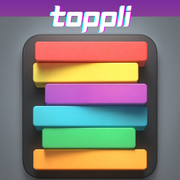
Toppli — Daily Stacking Challenge
Toppli is the curveball on this list — and the reason we wrote it. Toppli's Daily Challenge takes the Wordle template and applies it to a reflex game instead of a word puzzle. Every player worldwide gets the exact same sequence of block movements on the same calendar day, generated from a seeded random algorithm. Your tap timing is your own, but the pattern is shared. So the leaderboard becomes a comparison of skill on identical conditions — not on different randomness.
It scratches the same "I want a fresh tiny challenge with my morning coffee" itch Wordle does, but for people who'd rather test reflexes than vocabulary. Streaks reset at your local midnight, replays are unlimited within the day, and the whole thing is free forever — no paywall on the daily, no ads during it. We wrote a deeper piece on how the seeded-random mechanic works if you want the technical side.
No. 6
Quordle (and Octordle, Sedecordle, etc.)
Wordle, but you're solving four (or eight, or sixteen) puzzles simultaneously, with every guess applying to all of them. The mental load is genuinely different — you stop chasing the perfect first guess and start playing the percentages across multiple boards. Quordle (four) is the sweet spot most players settle on. Octordle and Sedecordle exist for masochists. All free, all daily, all browser-based with iOS app wrappers.
No. 7
The Mini Crossword
Predates Wordle by years but became way more popular in its wake — the Mini is the NYT's gateway crossword. A 5×5 grid with eight to ten clues, solvable in under two minutes once you've done a few. It's the lowest-stakes way to develop crossword intuition without committing to the full daily NYT crossword, which can take experienced solvers 45+ minutes on a Saturday.
How to pick one (or three)
If you're starting from zero with daily puzzle games, here's the easy mood-based version:
- Want the original? Wordle.
- Want the smarter sibling? Connections.
- Want something meditative? Spelling Bee or Strands.
- Want a daily that's NOT a word game? Toppli.
- Want to grind? Quordle.
- Want to develop crossword skills? The Mini.
Most committed daily-puzzle people end up running a stack of three or four — usually Wordle + Connections + one non-word game + one reflex or visual game. The whole rotation takes about ten minutes a day and somehow becomes one of the more reliably enjoyable parts of a morning.
Why the daily puzzle format isn't going anywhere
The reason this genre took over isn't the puzzles themselves — most of these mechanics have existed for decades. The reason is the social architecture Wordle accidentally invented: a tiny game where everyone in the world is solving the same problem, on the same day, in a thirty-minute overlap window. That creates a kind of frictionless conversation starter that almost no other game design produces. Your coworker can ask "did you get today's Wordle?" or "what did you get on Toppli?" and the answer is meaningful because you both played the exact same thing.
That's also why daily games tend to have such absurdly long lifespans. Wordle is four years old and still in the top 10 most-played mobile games globally. The Mini Crossword is older than the iPhone. The daily-puzzle slot in your morning routine is one of the most defensible bits of attention in mobile gaming — once you're in someone's daily habit, you're nearly impossible to dislodge. We wrote about the underlying psychology of one-tap and daily mechanics here if you want to dig into why they work.
The world doesn't need another Candy Crush. It needs more small, free, daily puzzles you can finish in under five minutes — games that respect your time and reward you for showing up. The seven games on this list all do that, in their own ways. Pick two, add them to your morning rotation for a month, and see which one sticks. The one that does will be on your phone five years from now.